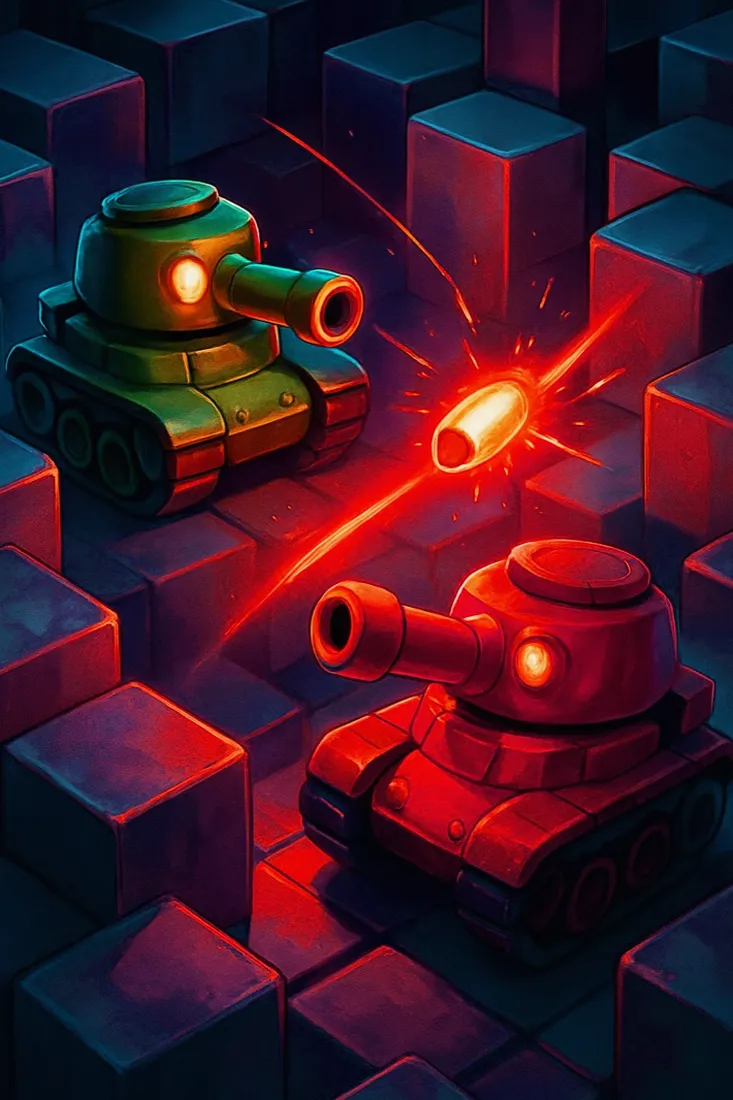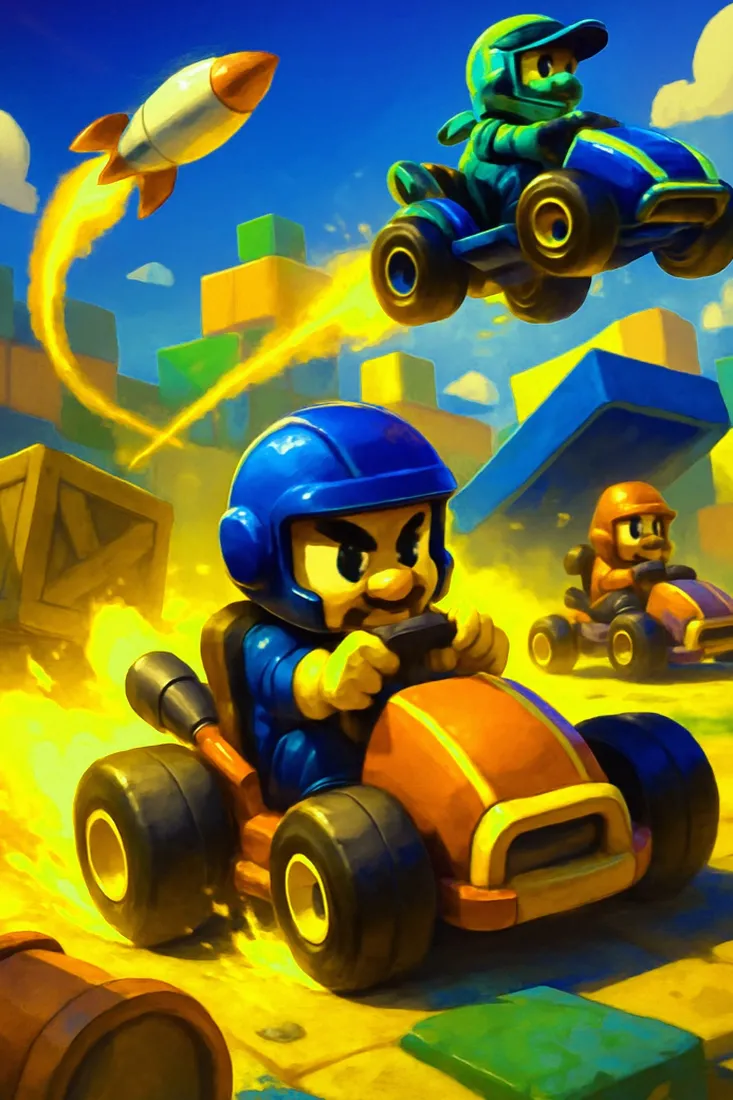
Smash Karts has the cleanest pitch of any game we cover. There is no track and no finishing line. You drive around a compact arena, run over crates, and each crate gives you a weapon at random. Score points by hitting the other drivers. When three minutes are up, the leaderboard decides the round and the next match begins. That is the whole thing, and it works beautifully.
The game comes from Tall Team, a small studio that also publishes it on phones, and the browser version at the official site loads straight into the menu with no install. Up to eight karts share an arena, which is the right number: busy enough that something is always exploding nearby, small enough that you can track the player who keeps dropping mines behind you and plan your revenge.
Crates, rockets and a little revenge
Weapons arrive through crates scattered around the arena, and the draw is random. You might pull a machine gun that chews through a rival at close range, a rocket that rewards a decent lead on a moving target, or a mine that sits in a doorway waiting for someone careless. The randomness keeps strong players honest, because even the best driver occasionally has nothing but a bad pickup and a target on their back.
That does not make it mindless. Good players learn where crates cluster, approach corners with a weapon already in hand and avoid driving in straight lines when someone behind them is armed. Mines in particular reward map knowledge, because the narrow gaps between obstacles are where everybody wants to drive. The skill ceiling is lower than Krunker's, but there is more craft here than first glances suggest.
Why three minutes is the magic number
Three-minute matches change how the game feels. A bad round is over before frustration settles in, and a good one ends while you still want more, which is exactly when you press the button to queue again. It also means Smash Karts fits around life rather than demanding an evening, and we found ourselves playing it in the gaps between longer sessions of the other five games on this list.
Scores reset every match, so there is no running tally to protect and no reason to avoid a lobby full of regulars. Some players will always be better, but the gap between a newcomer and a veteran is narrower here than anywhere else we tested. Time to first fight scores a perfect ten: from opening the page to firing your first rocket takes well under a minute.
The capsule machine and the long tail of unlocks
Between matches you earn coins, and those coins feed a capsule-style machine that hands out new characters and karts. Some characters are rarer than others, and collecting them is clearly the hook designed to keep you coming back across weeks. It is entirely cosmetic: a rare character drives exactly like the starter, so nothing you unlock tips a match.
We like that the unlock machine runs on coins you earn by playing, and we found the pace of rewards reasonable for regular players. The menus do offer ways to speed things up with purchases, and the adverts between matches are frequent. That is the trade for a free game this polished, and it explains a free-player score of eight rather than higher. Nothing here undermines the fairness of the match itself.
Where the shine wears thin
The weakness of a simple game is that it stays simple. After a couple of weeks we had seen most of what the arenas offer, and the core loop of drive, collect, fire does not deepen in the way Krunker's movement or Starblast.io's tech tree does. Players looking for a long-term skill project will feel the ceiling sooner here than anywhere else on the list.
Steering also feels deliberately loose. Karts slide around corners and bounce off each other, which is part of the comedy, but it means precise driving is less rewarded than you might want. Our movement score of seven reflects that: fun, readable, but not a handling model you will spend months mastering. For the game's purpose, a quick, cheerful brawl, those limits barely matter.
Your first week in Smash Karts
- Play a handful of matches without worrying about score; learn where crates appear on each arena.
- Keep moving at all times, especially in a curve; straight lines make you the easiest target in the lobby.
- Save mines for the narrow gaps between obstacles, where rival drivers have nowhere else to go.
- Lead your rockets slightly ahead of moving karts rather than firing straight at them.
- Use the coins you earn on the unlock machine once you have a favourite arena; there is no rush.
What we love
- Three-minute matches that fit into any gap in the day.
- No racing line to learn, so beginners score points immediately.
- Random crates keep matches unpredictable and lively for every skill level.
- Unlocks are purely cosmetic and earned with coins from normal play.
What grates
- The core loop runs out of surprises sooner than deeper games on this list.
- Adverts between matches are frequent enough to break the rhythm.
- Loose handling limits how much precise driving is ever rewarded.
Who Smash Karts is built for
Smash Karts suits anyone who wants a quick, cheerful fight with no homework. It is the game we recommend to friends who say they are no good at shooters, to families sharing a laptop, and to regulars of the other five games when they want ten minutes of simple noise.
Smash Karts: the final buzzer
Smash Karts does one thing and does it very well. Small arenas, random weapons and three-minute matches make it the most approachable game on our list and the one most likely to raise a laugh. It lacks the long-term depth that keeps Krunker at the top, and the adverts are persistent, but as a pick-up-and-play brawler it is close to ideal. Our second pick, and the easiest recommendation we make.